
Taxation and labor costs in Bulgaria: optimize profitability at the heart of the European Union
Favorable tax treatment for businesses in Bulgaria
The Bulgarian tax system is one of the most attractive and straightforward in the entire European Union. Designed to stimulate investment and attract foreign capital, it applies a unique flat tax policy.
Labor costs in Bulgaria are lower than the European average.
- 10% Corporate Income Tax (CIT): This rate on profits is the lowest in the EU. It allows outsourcing companies and startups to immediately maximize their operating margins.
- 10% Personal Income Tax (PIT): Entrepreneurs and employees who choose to relocate to Bulgaria benefit from this same flat rate on their personal income, guaranteeing excellent net purchasing power.
- 5% Dividend Tax: Profit distribution is taxed very little. This optimizes the returns for shareholders who decide to establish a company in Bulgaria.
Beyond taxes, the flexibility of the job market makes it possible to build highly qualified teams at very low operating costs.
- The minimum wage in 2026: As of January 1, 2026, the gross legal minimum wage is €620.20 per month. Although it is constantly being increased to keep pace with the country’s economic growth, this remains significantly below European standards.
- Reduced employer social security contributions: The burden of contributions is considerably reduced for employers. Overall social security contributions in Bulgaria amount to approximately 30% of salary. This contribution includes health insurance, social security, and entitlement to a European pension. The total cost of an employee remains predictable and transparent.
Operational costs and simplified management of intra-community VAT
Bulgaria offers an ecosystem conducive to international service provision thanks to fluid cross-border invoicing rules.
- Cash flow optimization: This system allows for the accounting of intra-Community VAT without any cash outflow, eliminating tax advances for outsourcing platforms.
- Registration threshold: Bulgarian VAT registration is mandatory if a company’s turnover exceeds €51,130 per calendar year (equivalent to BGN 100,000).
- VAT reverse charge: For cross-border B2B services within the European Union, the reverse charge mechanism applies.
Why is Bulgaria the major BPO hub in Europe?
Business Process Outsourcing (BPO) finds its most successful application in Europe in Bulgaria. The country not only offers low costs but also a first-rate service infrastructure.
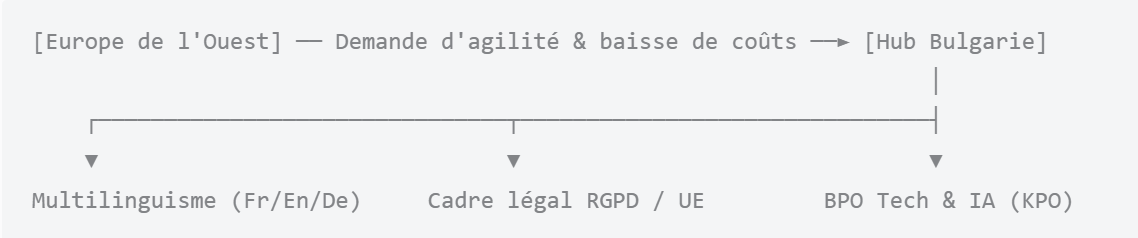
Multilingualism as a driving force
Sofia and Plovdiv boast a wealth of talent capable of working in over 30 languages. French, English, German, and Italian are mastered at a bilingual level thanks to a dense network of language schools and international universities. Your Western clients benefit from local support, free from language barriers.
Types of BPOs operated in Bulgaria
- Customer Operations (Front-Office) : Support technique d’excellence, services après-vente (SAV), gestion de modération de contenus et helpdesk informatique.
- Corporate Functions (Back-Office) : Externalisation comptable, gestion transfrontalière de la paie, saisie et enrichissement de bases de données.
- Knowledge Process Outsourcing (KPO) : Développement de logiciels, gestion de campagnes marketing de précision, et support légal ou conformité.
Company formation in Bulgaria: A guide to the legal steps
Taking advantage of this unique framework requires creating a local legal structure. Bulgarian legislation, aligned with EU directives, makes company formation quick and transparent.
Choosing your legal form: OOD or EOOD?
For the vast majority of outsourcing and service projects, the limited liability company is the ideal structure.
- The EOOD: A single-member limited liability company (ideal for an entrepreneur or a wholly-owned subsidiary).
- The OOD: A limited liability company with at least two members.
The step-by-step constitution process
- Choosing and reserving the name: The business name must be unique and registered with the Bulgarian Commercial Register (Търговски регистър).
- Minimum share capital: A major advantage is that the minimum legal share capital for a Bulgarian Business Ownership Company (OOD/EOOD) is only 2 BGN (approximately €1). However, it is advisable to deposit a capital amount more in line with your ambitions.
- Opening the escrow account: The share capital must be deposited into a temporary bank account in Bulgaria to obtain the deposit certificate.
- Official registration: The legal documents (articles of association, powers of attorney, declarations of conformity) are submitted to the Register. Registration typically takes between 3 and 5 business days.
- Tax activation and VAT number: As soon as the unique identification code (EIK) is obtained, the application for an intra-community VAT number (BG…) is initiated to begin European operations.
Succeeding with your outsourcing project in Bulgaria: An operational guide
Combining the creation of your structure with a BPO strategy requires a methodical approach to transform the project into tangible financial success.
Define the implementation model: Wholly owned subsidiary or service provider?
- The subsidiary (captive center) option: You create your own entity (EOOD) and directly recruit your Bulgarian employees. This model is ideal if you want to maintain complete control over your expertise and processes.
- The local BPO partner option: You outsource your operations to an established BPO agency in Bulgaria. You avoid the administrative management of human resources and benefit from immediate volume flexibility.: You create your own entity (EOOD) and directly recruit your Bulgarian employees. This model is ideal if you want to maintain complete control over your expertise and processes.
- The local BPO partner option: You outsource your operations to an established BPO agency in Bulgaria. You avoid the administrative management of human resources and benefit from immediate volume flexibility.
Establish a rigorous service level agreement (SLA)
In the case of subcontracting, the contract must lock in key performance indicators (KPIs) aligned with your Western European standards:
- First Contact Resolution (FCR): Customer ticket resolution rate on the first call or email.
- Accounting Processing Time: Speed of data entry and invoicing.
- Staff Turnover Rate: Tracking of talent retention on your dedicated account.
Comparative summary: France vs Bulgaria
To measure the immediate impact on your company’s profitability, this table highlights the competitiveness gap between the two ecosystems:
| Economic Indicator | France Model (Average) | Bulgaria Model (2026) | Strategic Advantage |
| Corporate Income Tax | 25,00% | 10% (Flat Tax) | +15% net margin maintained |
| Dividend Tax | 30% (PFU / Flat tax) | 5,00% | Optimized shareholder remuneration |
| Gross Minimum Wage | ~€1,800/month | €620.20 / month | Massive payroll reduction |
| Employer Social Security Contributions | ~45% in addition to salary | ~30% in addition to salary | Predictable and controlled total employee cost |
| Time Zone | UTC+1 | UTC+2 | Perfect work synergy (1-hour difference) |
Comparative summary: Belgium vs Bulgaria
To measure the immediate impact on your company’s profitability, this table highlights the competitiveness gap between the two ecosystems:
| Economic Indicator | Belgium Model (2026) | Bulgaria Model (2026) | Strategic Advantage |
| Corporate Tax | 25% (standard rate, reduced to 20% on the first €100,000 under certain conditions) | 10% (Flat Tax) | +15% net margin retained in Bulgaria. |
| Dividend Tax | 30% (standard withholding tax, reduced to 18% under the VVPRbis scheme) | 5,00% | Shareholder remuneration highly optimized in Bulgaria. |
| Gross Minimum Wage | €2,189.81/month (38 hours/week) | €620.20 / month | Massive reduction in base payroll (approximately €1,569 difference). |
| Employer Social Security Contributions | ~27% to 30% in addition to salary (excluding indexation and sector-specific benefits) | ~30% in addition to salary | Overall costs controlled on both sides, but the Bulgarian base payroll is significantly lower. |
| Time Zone | UTC+1 | UTC+2 | Perfect synergy in working arrangements (only a 1-hour difference). |
Key takeaways from this comparison :
- Profit optimization: Bulgaria allows companies to retain a significantly larger share of their profits thanks to its flat corporate tax rate of 10%, whereas Belgium imposes the standard European rate of 25%.
- Wage pressure: Belgium has one of the highest minimum wages in the EU (exceeding €2,100), coupled with an automatic inflation-linked indexation mechanism. Bulgaria remains a highly cost-competitive outsourcing destination.
Conclusion and outlook: The choice of sustainable performance
Choosing Bulgaria for your company’s incorporation or as a base for your BPO operations is not simply a matter of short-term accounting optimization. It’s a highly strategic decision. By combining a corporate tax rate of 10%, unique within the EU, a pool of highly trained, multilingual talent, and a completely secure legal framework, the country offers the most stable and competitive environment in Europe to boost your operating margins.
- Business Process Outsourcing (BPO) in Bulgaria: the key driver of your competitiveness
 In a hyper-competitive economic environment, reducing operating costs and optimizing business processes have become top priorities for Western European companies. Faced with continuously rising wages… Read more: Business Process Outsourcing (BPO) in Bulgaria: the key driver of your competitiveness
- Holding company in Bulgaria: How to optimize the ownership of your European subsidiaries?
 Faced with increasing taxation and administrative complexity in many countries, restructuring a group is becoming an essential competitive advantage for business leaders. To manage subsidiaries… Read more: Holding company in Bulgaria: How to optimize the ownership of your European subsidiaries?
- France-Bulgaria tax treaty: How to avoid double taxation?
 Internationalizing business activities and assets has become a common strategy for entrepreneurs and investors seeking to maximize profitability within the European Union. However, working or… Read more: France-Bulgaria tax treaty: How to avoid double taxation?
- Setting up an EOOD and OOD company in Bulgaria: A guide for agile entrepreneurs
 Digital nomadism, freelancing, and cross-border entrepreneurship have profoundly changed our relationship with work. For service providers, developers, consultants, or content creators seeking optimal profitability, Bulgaria… Read more: Setting up an EOOD and OOD company in Bulgaria: A guide for agile entrepreneurs
- Company formation in Bulgaria for e-commerce and services in the EU
 Bulgaria has become one of Europe’s most attractive destinations for web entrepreneurs looking to set up a new company. Whether you’re launching an online store… Read more: Company formation in Bulgaria for e-commerce and services in the EU